

In a Nutshell
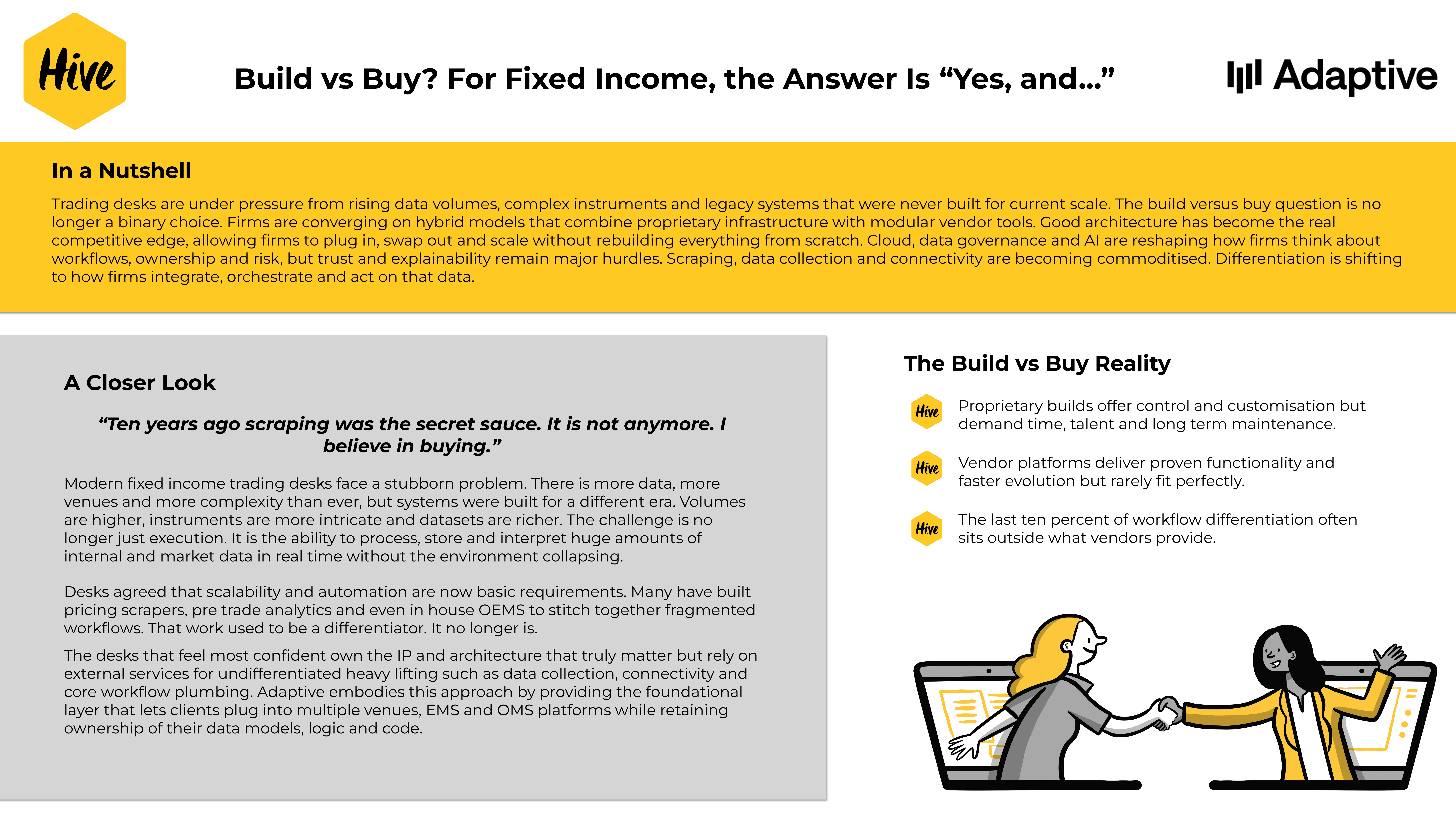
Good architecture has become the real competitive edge, allowing firms to plug in, swap out, and scale without rebuilding everything from scratch.
A closer look
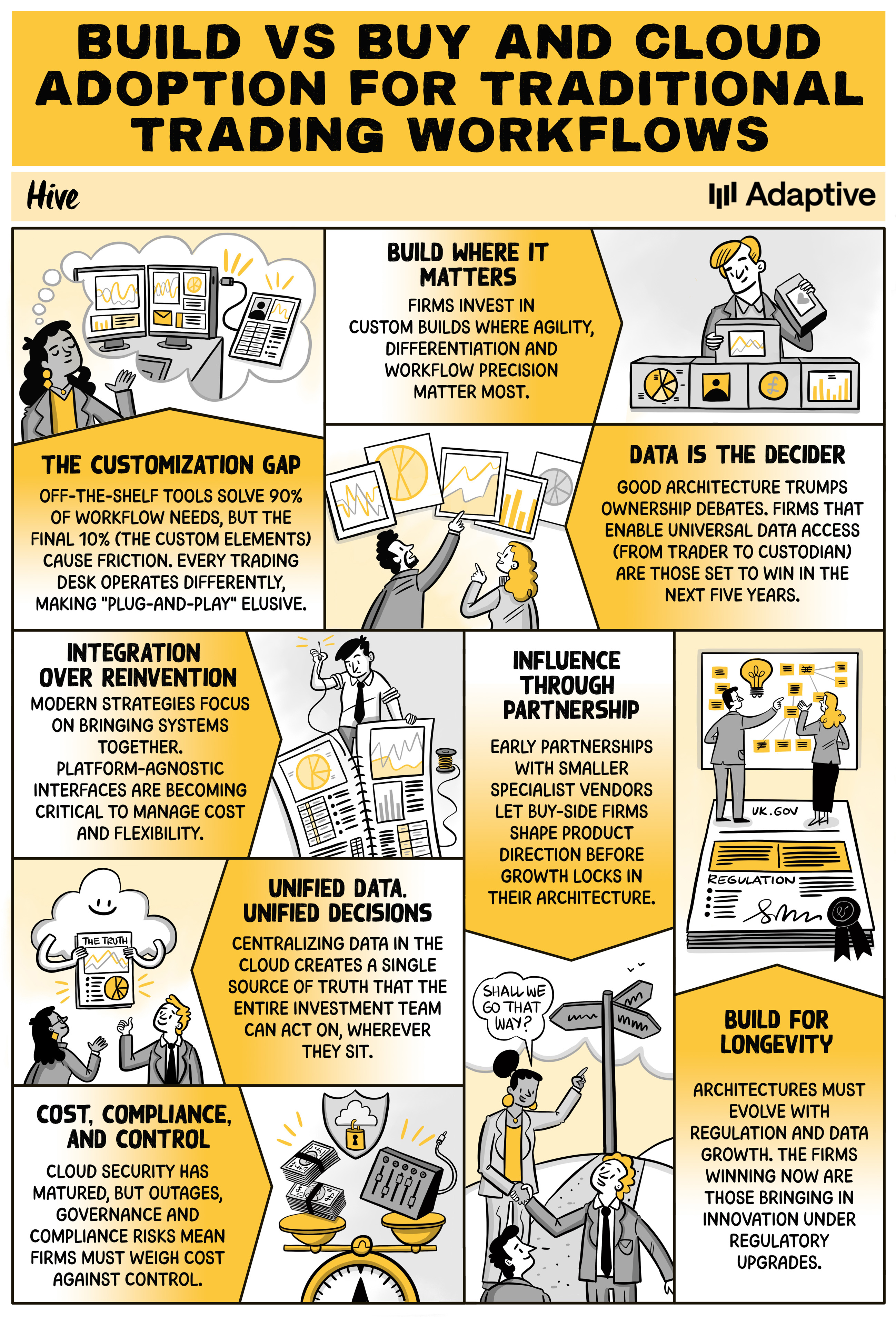
Modern fixed-income trading desks are running into a simple but stubborn problem. There is more data, more venues, and more complexity than ever, but the systems meant to handle it were built for a different era. Volumes are higher, instruments are more intricate, and datasets are richer. The challenge is no longer just about executing trades efficiently. It is about processing, storing and interpreting enormous amounts of market and internal data in real time, without everything grinding to a halt.
Around the table, there was a clear sense that scalability and automation are now basic requirements rather than nice-to-have features. Many firms have spent years building tools such as pricing scrapers, pre-trade analytics, and even in-house OEMS to bring together fragmented workflows. One participant described how their journey began 15 years ago with a scraping tool that created a robust dataset of executable prices across fixed income, which then became the backbone for algo pricing and pre-trade analytics. That kind of work used to be the secret sauce. It no longer is. As one attendee put it, “ten years ago, scraping was the secret sauce. It is not anymore. I believe in buying.”
The build vs. buy reality
This shift naturally leads to the core question: build or buy? Proprietary builds give firms full control and deep customization. They allow workflows to reflect how a particular desk actually trades, rather than how a generic system expects them to trade. But they demand time, talent, and a willingness to maintain complex infrastructure indefinitely. Vendor platforms, by contrast, can deliver proven functionality quickly, but they rarely fit perfectly. “Most solutions cover eighty or ninety percent of what we need,” one firm noted. “The last ten percent is where our differentiation lives, and that is the hardest part to get from a vendor.”
Architecture becomes the edge
What emerged from the discussion was not a choice but a philosophy. “Build versus buy, it is yes, and.” The desks that feel most confident are those that own the architecture and the IP that truly matters, but rely on external services for undifferentiated heavy lifting, such as data collection, connectivity, and basic workflow components. Adaptive reflects this mindset in its own positioning. Rather than delivering a fully bespoke stack from the ground up, it focuses on providing the foundational layer that lets clients plug into multiple venues, EMS, and OMS platforms, while retaining ownership of their data models, logic, and code. Platform agnostic by design, this approach “takes out the bottom layer” and gives firms room to innovate on top.
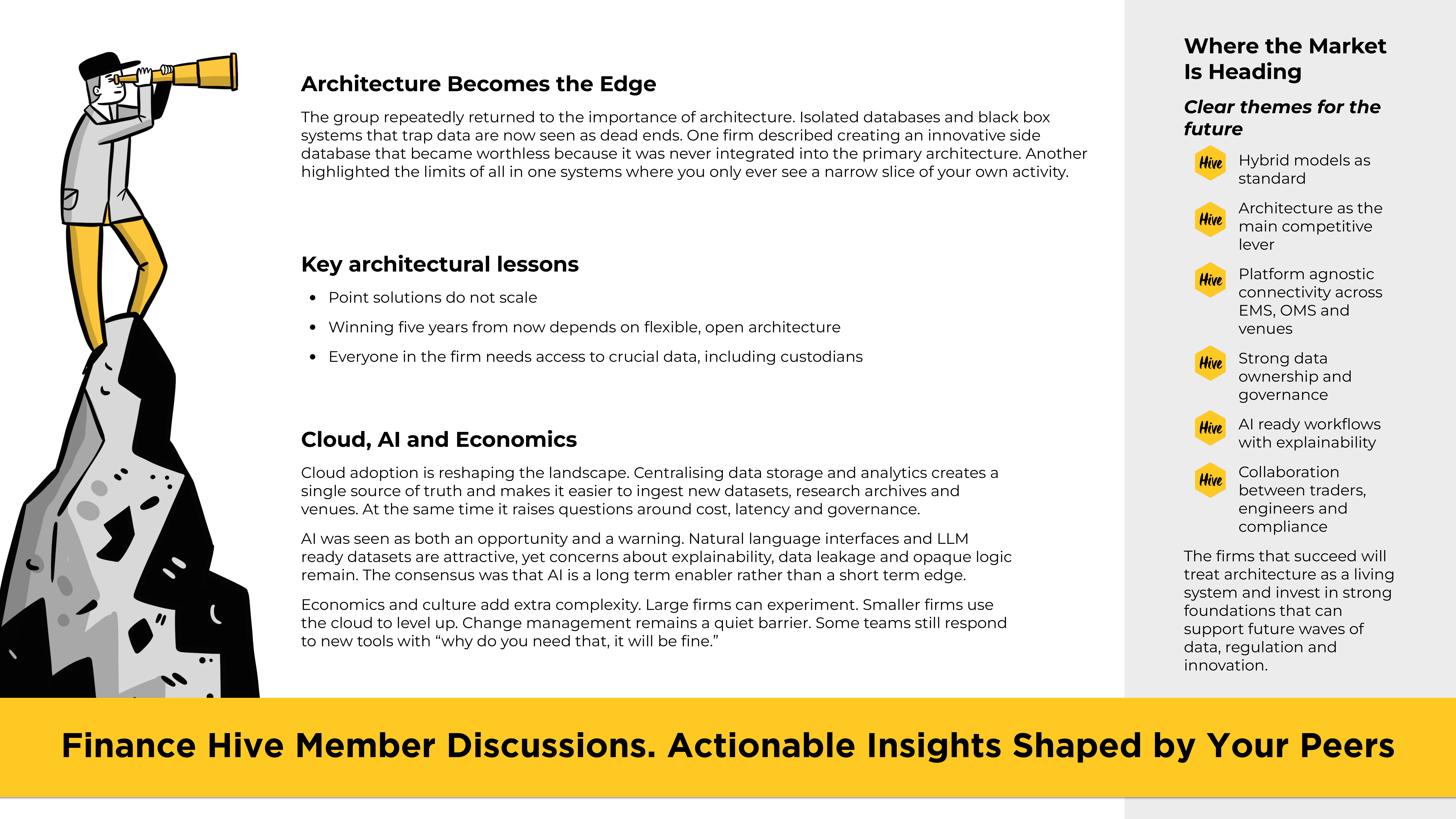
The conversation returned repeatedly to architecture. Old standalone databases that sit outside the main environment and cannot be integrated are now seen as dead ends. So are systems that trap data inside proprietary black boxes. One participant described building an innovative side database that eventually became worthless because it was never integrated into the firm’s primary data architecture. Another highlighted the limitations of all-in-one platforms, where “you do not get any of the data that goes in, you only see your trades and the cover, and if you do not trade it is gone.” The lesson was clear. Point solutions do not scale. “Winning five years from now comes down to good architecture,” one attendee said. “How do you enable everyone in your company to have access to crucial data, even the custodian?”
Cloud, AI, and economics
Cloud adoption is changing the picture. Centralising data storage and analytics in the cloud has given some firms a single source of truth across trading, risk, and portfolio management. It has also made it easier to ingest third-party datasets, LLM-ready research archives, and new venues without having to rebuild pipelines each time. At the same time, it introduces new questions about cost, latency, and governance. Consumption-based pricing can flatten upfront spend, but becomes unpredictable as usage grows. Cross-border data rules, encryption standards, and auditability requirements all need careful design, particularly as AI enters the stack.
AI was treated as both an opportunity and a cautionary tale. Traders and technologists in the room are excited about natural language interfaces that can sit on top of research, filings, analyst calls, and dealer chats, turning unstructured flows into structured, searchable inputs. Several firms are already building large databases specifically to feed LLMs, while others are happy to consume that service from external providers and focus on their own models and interfaces. There is interest in chatbot-style tools that can query positions, surface opportunities, and visualize risk in real-time. Yet there is also a widely shared scepticism. Many models can deliver eighty percent accuracy, but the final twenty percent is where real money is made or lost. Compliance teams are concerned about data leakage, opaque logic, and AI-generated code that nobody fully understands. Early adopters may gain experience, but they also carry reputational risk. The table largely viewed AI as a long-term enabler, rather than a short-term edge.
Economics and culture add another layer of complexity. Large firms may lean build first, with big engineering teams and a willingness to experiment across taxable, munis, and emerging markets. Even then, 2025 style resource constraints mean they need confidence that projects will deliver within budget and on time. Smaller and mid-sized firms increasingly look to the cloud to level the playing field, accepting that they cannot hire ten traders for every strategy and must instead rely on the “right algo price and the right quantamental approach.” As one participant summed it up, “If you have those things, I do not think you need ten traders.”
Change management remains a quiet but powerful theme. Old guard attitudes still exist. New tools are sometimes met with “Why do you need that? It will be fine,” which can slow progress. Successful teams are learning to “sneak in” upgrades by tying them to regulatory requirements or by making technology tangible. One firm described how every potential client who visits their trading desk experiences an “aha moment” when they see the in-house system running in real time. For many, that demonstration is more persuasive than any slide deck, because it turns abstract architecture into a visible competitive advantage.
Throughout the discussion, Adaptive’s role sat in the background as a kind of facilitator. Not the hero system that claims to do everything, but the connective tissue that makes hybrid strategies viable. In a world where no turnkey solution exists for all of a firm’s needs, the ability to integrate, orchestrate, and evolve is more valuable than any single application. “You need tech to stay in the game, and then add beyond it,” one attendee said. The firms that will thrive are not necessarily those that build the most or buy the most. They are the ones who design for change from the start.
Where the market is heading
Several clear themes emerged for the future of 'build and buy' in fixed income:
- Hybrid by default:
Firms will increasingly blend internal builds with modular vendor components, using external services for undifferentiated work and reserving in-house resources for true edge.
- Architecture as an advantage:
Flexible, open, and well-documented architectures will matter more than any single platform, allowing firms to plug in new tools and retire old ones without disruption.
- Platform agnostic connectivity:
Trading desks will expect EMS, OMS, and venue connectivity to work across providers, with interfaces that can be tailored without sacrificing robustness.
- Data ownership and governance:
Internal control of core datasets, models, and code will remain non-negotiable, even as firms lean on cloud and external services for processing and analytics.
- AI-ready workflows:
Desks will build processes and data models that can feed and consume AI tools safely, with a focus on explainability, auditability, and clear lines of responsibility.
- Culture and skills:
Technology decisions will increasingly depend on collaboration between traders, engineers, and compliance, with upskilling across all three seen as essential.
In this landscape, ‘build versus buy’ is no longer a choice to be made once. It is an ongoing discipline. The firms that succeed will treat architecture as a living system, investing in foundations that can support whatever the next wave of data, regulation, and innovation brings.
Talk to us!
